Timor-Leste National Institute of Statistics Partners with SEI and UN Women to Launch Municipal Gender Profile
Dili, 18 August 2026 – The Ministry of Finance, through the President of INETL, I.P., and the Secretariat of State for Equality (SEI), in partnership with UN Women Timor-Leste, officially launched the Gender Profile of Municipalities in Timor-Leste.
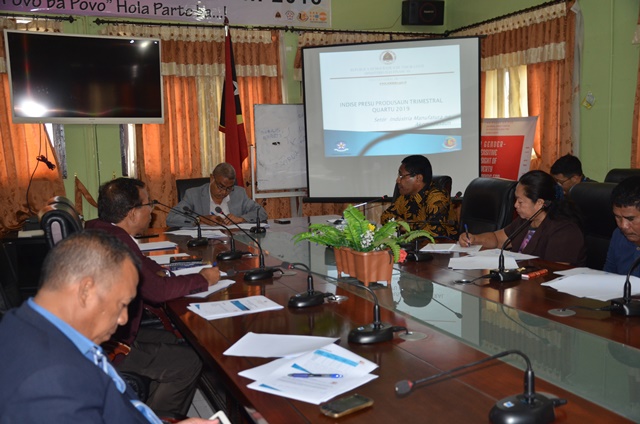
The documents were officially launched by Her Excellency the Secretary of State for Equality – SEI, Elvina Sousa Carvalho, together with the UN Resident Coordinator, Ms. Olufunmilayo (Funmi) Balogun-Alexander; the President of the National Institute of Statistics Timor-Leste (INETL, I.P.), Mr. Elias dos Santos Ferreira; the Head of Mission of UN Women Timor-Leste, Ms. Amy Nishtha Satyam; the Director-General of Decentralization and Local Government (DG-DGL), Mr. António Augusto Guterres; the President of the Dili Municipal Authority, Mr. Francisco dos Santos; and the President of the Timor-Leste Women’s Network, Ms. Zélia Guterres.
These official documents are of great relevance to Timor-Leste’s decentralization development agenda. They provide practical evidence for municipalities and national institutions to identify gaps, determine investment priorities, and strengthen gender-responsive planning, policy development, budgeting, service delivery, and monitoring.
In his intervention, INETL President, Sr. Ferreira, extended his gratitude to everyone for their presence at the launch of the Gender Profile of Municipalities in Timor-Leste. She noted that the profiles represent an important step toward strengthening evidence-based decision-making and promoting gender equality across the country. These profiles were developed using official statistics from the 2022 Timor-Leste Population and Household Census, produced by the National Institute of Statistics of Timor-Leste and the Ministry of Finance, in close collaboration with UN Women and the State Secretariat for Equality. The profiles provide comparable and localized information for 13 municipalities in Timor-Leste and the Oe-Cusse-Ambeno Special Administrative Region.
This product is the result of the 2022 Population and Household Census. Following the census, the Institute has published the Final Results, 12 Thematic Reports, and Return Census Results (per village) throughout Timor-Leste. These profiles are not just a collection of statistics — they are practical tools for understanding where inequalities exist, who is being left behind, and what action is needed. When gender data is brought closer to municipalities and communities, that data can help policymakers improve planning, direct resources more effectively, and develop programs that respond to the realities of women, men, girls, and boys in different parts of the country.
These results show progress, but also point to pressing challenges.
First, in 13 of the 14 municipalities, the majority of the population lives in rural areas, and children under the age of 15 represent about one-third of the population. This situation creates a need for greater and ongoing care. In many households, responsibility for child care and household chores is carried out mainly through unpaid work, and this work is mostly done by women and girls.
Second, the Profiles show that gender inequality starts early and increases throughout the lifespan. Early marriage still affects young women in some municipalities. In almost all municipalities, women and girls are more likely to never attend school than men and boys. These barriers reduce opportunities for capacity development, employment, and income generation.
Third, women continue to face barriers in the labour market. Women’s labour force participation is even lower than men’s in the municipalities, and family caregiving is identified as an important reason for this difference. Even when women are employed, they are more likely than men to work in vulnerable jobs. Many livelihoods are also closely linked to subsistence production, especially in rural areas.
Fourth, women and girls with disabilities face multiple and intersecting forms of disadvantage. In the municipalities, between 58 and 89 percent of women and girls with disabilities, aged five and above, never go to school. These educational barriers are linked to poorer outcomes in employment and social participation in later life stages.
Therefore, we must ensure that gender equality initiatives include people with disabilities. This means strengthening inclusive education, improving accessibility to services and infrastructure, and increasing good and safe employment opportunities for women with disabilities. The intersectional approach is vital if we are serious about ensuring that no one is left behind.
The launch of these Profiles should mark the beginning of action, not the end of analysis. I encourage national institutions, municipal authorities, civil society, development partners, and communities to use these Profiles in concrete ways.
We should use the Profiles to identify a limited number of priorities in each municipality, link those priorities with planning and budgeting, assign responsibility to institutions, and monitor progress over time. We must also strengthen the link between national statistics and local planning, ensuring that data is not just produced, but actively used to improve people’s lives.
At the same time, we must acknowledge the limitations of census data. The Profiles do not directly measure all dimensions of gender equality, including gender-based violence, decision-making, control of assets and resources, access to financial services, income, working conditions, or unpaid care and domestic work. These areas will require complementary data sources, including administrative data and time-use research.
Let us use this evidence to strengthen girls’ education, reduce and share unpaid care work, increase women’s access to productive resources and good services, improve social protection, and ensure full inclusion of women and girls with disabilities.
Let us also ensure that gender data becomes part of everyday governance—part of the way we plan, budget, implement, coordinate, and measure results.
Together, we can turn these Profiles into practical change: more inclusive work, better opportunities, stronger communities, and sustainable economic development that benefits everyone.
I would like to thank the Secretariat of State for Equality, UN Women, and all partners who have contributed to this important work.
The discussion of the Government Policy Priorities (PPG), which began on 17 August 2026 and runs until 27 August 2026, offers an opportunity to use these data as evidence to inform decisions that promote gender equality throughout the country.
I noted that the Director-General of Decentralization and Local Government, along with representatives of the State Ministry, also participated. They requested that these publications be included in the Municipal Profile, along with other census results, so that everyone can access them.